Monosaccharides represent the monomeric units, indivisible by hydrolysis, that constitute the cornerstone of carbohydrate chemistry and whose study has been crucial in the development of biochemistry.[1]
Endowed with an apparently simple basic structure, they show remarkable diversity, allowing them to be classified based on carbon chain length, the nature of the carbonyl group, and the ability to form furanose or pyranose rings.[2] The presence of chiral centers confers stereochemical properties, determining the existence of enantiomers, diastereomers, and anomers.[3]
From a chemical standpoint, the reactivity of hydroxyl and carbonyl groups accounts for intramolecular cyclization mechanisms, spatial ring conformations, and the ability to act as reducing agents.[4]
These structural features translate into essential biological functions: from rapid cellular energy supply to the synthesis of oligo- and polysaccharides, up to the formation of modified derivatives and glycoconjugates crucial for cellular recognition and signaling.[5]
Summary: Key Points
- Definition: monosaccharides are the fundamental constituents of carbohydrates and pillars in the development of biochemistry.
- Classification: they are classified based on carbon chain length and the nature of the functional group into aldoses and ketoses.
- Stereochemistry: the presence of chiral centers generates numerous stereoisomers, while intramolecular cyclization produces anomeric carbons and α and β configurations.
- Chemical properties: in solution, they form furanose or pyranose cyclic structures predominantly adopting a chair conformation, also acting as reducing agents thanks to the free carbonyl group.
- Biological functions: they are a rapidly available energy source and constitute the building blocks for oligosaccharides, polysaccharides, and membrane glycoconjugates essential for cellular recognition.
Contents
Classification
There is no single classification criterion for monosaccharides: they can be classified based on various structural and functional properties, including carbon chain length, the nature of functional groups, the tendency to form cyclic structures, stereochemical characteristics, and chemical reactivity.
Chain length
The simplest monosaccharides contain three carbon atoms and are thus defined as trioses, represented by glyceraldehyde and dihydroxyacetone. The classification continues with tetroses (four carbon atoms), pentoses (five), and hexoses (six); the latter are among the most abundant and biologically relevant in nature.[6]
Functional group
Based on their functional group, monosaccharides are divided into aldoses, if they possess a terminal aldehyde group, and ketoses, if they possess a ketone group within the carbon chain. Combining the functional group and chain length, the most common monosaccharides can be subdivided into aldotrioses and ketotrioses, aldotetroses and ketotetroses, aldopentoses and ketopentoses, up to aldohexoses and ketohexoses possessing six carbon atoms.[1]
Furanose and pyranose
Monosaccharides can form heterocyclic ring structures, which, based on the number of atoms composing the ring (including the hemiacetal oxygen atom), are categorized as follows:
- Furanose forms, named by analogy with furan, a five-membered heterocycle consisting of four carbons and one oxygen.
- Pyranose forms, named by analogy with pyran, a six-membered heterocycle consisting of five carbons and one oxygen.[2]
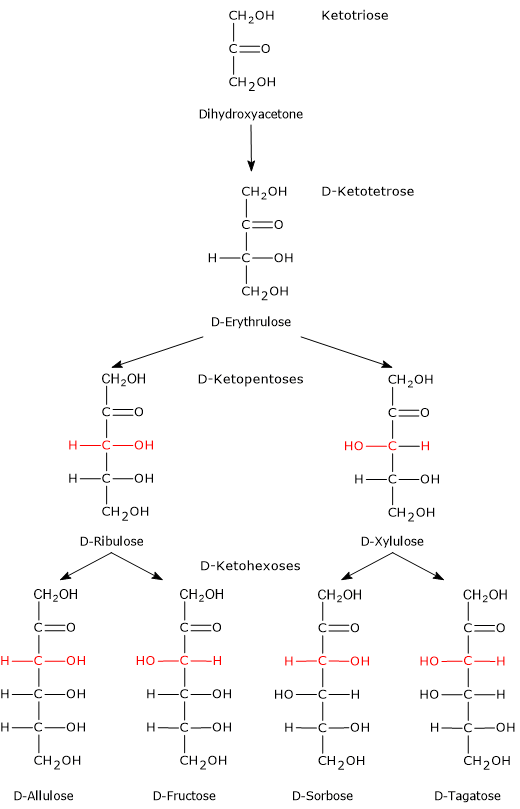
| Class (C atoms) | Aldoses (main examples) | Ketoses (main examples) | Prevalent cyclic form in solution |
|---|---|---|---|
| Trioses | D-Glyceraldehyde | Dihydroxyacetone | Open chain (do not cyclize) |
| Tetroses | D-Erythrose, D-Threose | D-Erythrulose | Predominantly open chain |
| Pentoses | D-Ribose, D-Xylose, L-Arabinose | D-Ribulose, D-Xylulose | Furanose or pyranose |
| Hexoses | D-Glucose, D-Galactose, D-Mannose | D-Fructose | Pyranose (glucose ≈ 99%; fructose ≈ 67%) |
| Heptoses | D-Glycero-D-manno-heptose | D-Sedoheptulose | Pyranose or furanose |
Stereochemical properties
Monosaccharides are molecules possessing multiple chiral centers along the carbon chain. The presence of asymmetric and stereogenic centers determines the existence of numerous stereoisomers and governs their biological specificity. This structural complexity is further increased by the stereochemistry of the intramolecular cyclization reaction leading to ring closure, which converts the carbonyl carbon into a new center of chirality and generates new diastereomers with distinct behaviors in solution.[3]
Chirality and stereoisomerism
Aldoses starting from three carbon atoms and ketoses with at least four carbon atoms exhibit chirality, meaning they possess at least one carbon bonded to four different ligands, excluding the carbonyl carbon and terminal chain carbons.[7]
The presence of at least one chiral or stereogenic center determines the existence of stereoisomers, whose maximum number is given by the formula 2n, where n is the number of chiral centers present. For ketoses, the internal carbonyl group, usually at position two, reduces the number of possible chiral centers by one compared to the corresponding aldose with the same number of carbon atoms; consequently, the maximum number of stereoisomers for ketoses is calculated using the formula 2N-3, where N is the total number of carbon atoms in the chain.[4]
In the simplest case, the aldotriose glyceraldehyde (n = 1), there are two stereoisomers designated according to the Fischer-Rosanoff convention as D-glyceraldehyde and L-glyceraldehyde.[8] Considering D-glucose, an aldohexose with four chiral centers, we obtain its enantiomer, L-glucose, and fourteen diastereomers, including the epimers galactose and mannose. Adding the starting D-glucose yields a total of sixteen stereoisomers. Analyzing D-fructose, a ketohexose with three asymmetric centers, there are 2(6-3) = 8 total stereoisomers, comprising the enantiomer L-fructose and six diastereomers.[4]
Note: for monosaccharides with more than one chiral center, the assignment of the D or L configuration refers to the chiral carbon farthest from the carbonyl group, that is, the one with the highest locant number in the carbon chain numbering, such as carbon five for aldohexoses and carbon four for aldopentoses. Two-dimensional graphic representations commonly employ Fischer projections.[5]
Anomers and α and β configuration
The carbonyl carbon characterizing the open-chain form, with sp2 hybridization and devoid of chirality, drives the cyclization reaction. Following ring closure, this atom transforms into a hemiacetal carbon in aldoses and a hemiketal carbon in ketoses, shifting to sp3 hybridization. Since it now binds four different substituents, it becomes a new stereogenic center, termed the anomeric carbon, giving rise to two possible diastereomers called α and β anomers.[3]
The formation of the two anomers is the direct stereochemical outcome of intramolecular nucleophilic addition. The carbonyl carbon, having trigonal planar geometry in the open form and bound to three different groups, presents two non-equivalent faces.[7]
Applying the Cahn-Ingold-Prelog (CIP) sequence rules, the same used to define the RS system of nomenclature, these two planar faces can be distinguished: one is termed Re, from Latin rectus, and the other Si, from Latin sinister.[9] Depending on which face undergoes nucleophilic attack by the hydroxyl group, one of the two anomers is selectively obtained; for instance, in D-glucose, attack on the Si face leads to the formation of the α anomer, whereas attack on the Re face generates the β anomer.[7]
In aqueous solution, the two anomers can interconvert through the open-chain intermediate in an optical phenomenon known as mutarotation, until reaching a dynamic equilibrium where the thermodynamically most stable form prevails. For D-glucose at room temperature, the equilibrium settles at approximately 63.6% β anomer and 36.4% α anomer, with less than 0.02% in the open-chain form.[5]
Chemical properties
Monosaccharides, or simple sugars, are organic molecules formed by three or more carbon atoms united by covalent bonds, featuring multiple hydroxyl groups and an aldehyde or ketone group, with the general formula, with few exceptions, of (CH2O)n, where n ≥ 3.[10]
Carbon, hydrogen, and oxygen atoms are present in a 1:2:1 molar ratio, which is why monosaccharides, like other carbohydrates, are also called hydrates of carbon, or, considering their aldehyde or ketone functional groups, respectively polyhydroxyaldehydes and polyhydroxyketones.[2]
At room temperature, they appear as colorless, crystalline solids that are highly soluble in aqueous solution, thanks in part to numerous hydroxyl groups that readily form hydrogen bonds. Most possess a sweet taste.[11]
Their chemical reactivity is determined by the aldehyde or ketone functional groups and the hydroxyl groups, which are responsible for intramolecular cyclizations, reducing capacity, and subsequent esterification, etherification, and glycosidic bond formation.[7]
Cyclization of monosaccharides
A hydroxyl group, via a nucleophilic addition reaction, can react with the carbonyl group of an aldehyde or ketone to yield a hemiacetal or hemiketal. This nucleophilic addition can occur spontaneously and without enzymatic catalysis in monosaccharides via an intramolecular reaction leading to ring closure, generating a cyclic hemiacetal or hemiketal.[7]
The probability of a molecule cyclizing depends on the thermodynamic stability of the formed ring, governed by geometric and energetic constraints described by:
- Baldwin’s rules, organic chemistry guidelines for predicting the kinetic and geometric feasibility of ring-closure reactions in acyclic compounds;[12]
- Baeyer strain theory, which describes bond instability resulting from deviation from ideal tetrahedral angles (109.5°); this strain reaches extremely high values in small rings such as cyclopropane and cyclobutane, with angles of approximately 60° and 90°, respectively;[13]
- entropic and steric factors, determining thermodynamic spontaneity, conformational degrees of freedom, and geometric feasibility based on substituent steric hindrance.[3]
Consequently, trioses cannot stably cyclize because nucleophilic attack would yield three- or four-membered rings characterized by bond angles well below 109.5° and unsustainable angular strain, compounded by strong steric hindrance. Therefore, in aqueous solution, trioses exist exclusively in the open-chain form.
Tetroses could theoretically form four- or five-membered rings, but cyclization is thermodynamically unstable, and in aqueous solution, the open-chain form remains predominant.[6]
Pentoses and hexoses
With pentoses and hexoses, cyclic forms are thermodynamically favored, yielding five- and six-membered rings. The same hexose or pentose can adopt both furanose and pyranose forms, although equilibrium composition is influenced by chemical characteristics and physical conditions such as temperature. For example, fructose at room temperature exists approximately 67% in the pyranose form and 33% in the furanose form, whereas glucose exists almost exclusively in the pyranose form.
Although seven-membered rings are theoretically possible with hexoses and heptoses, such as sedoheptulose in its phosphorylated form, an intermediate in the pentose phosphate pathway, their formation is thermodynamically unfavorable due to lower stability compared to five- and especially six-membered rings.[3]
Conformers and chemical reactivity
The sp3 hybridization of carbons involved in ring formation ensures that rings are not planar.[7]
Considering the pyranose ring, it can assume primarily two limiting conformations, known as boat and chair, whose stability depends on stereochemical interactions among ring substituents, particularly hydroxyl groups.[10]
In monosaccharides, the boat conformation is significantly less stable than the chair due to high torsional strain and steric hindrance. In the chair conformation, functional groups attached to ring carbons can orient into two distinct geometric positions:
- axial, oriented parallel to the ring symmetry axis, bringing them closer together and subject to unfavorable steric interactions;
- equatorial, oriented outward along the ring perimeter, staggered and characterized by reduced steric interactions.
Since these two conformational positions interconvert via ring flipping, each pyranose system predominantly adopts the chair conformation in which the maximum possible number of bulky substituents occupies equatorial positions.[6]
The spatial arrangement of functional groups directly influences monosaccharide chemical reactivity: for instance, equatorial hydroxyl groups are generally more accessible to reagents and esterify more easily than sterically hindered axial ones. A classic example is D-glucose: in its β-D-glucopyranose form, it is the only aldohexose capable of adopting a chair conformation where all hydroxyl groups and the terminal CH2OH group simultaneously occupy equatorial positions. This geometric configuration almost completely abolishes steric strain, explaining why D-glucose is the most stable and biologically abundant sugar in nature.[5]
Reducing sugars
Monosaccharides can be classified based on their ability to act as reducing agents in alkaline solutions toward mild oxidants such as cupric ions in Benedict’s reagent.
In aqueous solution, while trioses and tetroses exist predominantly or exclusively in open-chain form, pentoses and hexoses exhibit a small yet finite percentage of open-chain form in equilibrium with cyclic structures, ensuring a free aldehyde or ketone group. The aldehyde group can act directly as a reducing agent, whereas the ketone group, under strongly alkaline conditions, must first tautomerize via an enediol intermediate into an aldehyde group. Consequently, all monosaccharides are reducing sugars. During the redox reaction, monosaccharides oxidize into carboxylic acids (aldonic acids) while reducing the metallic ion.[11]
Functions
Monosaccharides fulfill numerous biological functions: they serve as a primary energy source for cells, act as building blocks for structural and storage polymers, and participate directly or in modified form in molecular recognition processes by binding to proteins and lipids.
Energetic role
Monosaccharides constitute a rapidly available energy source, providing approximately 3.74 kcal/g, frequently approximated to 4 kcal/g. In living organisms, the chemical energy contained in their covalent bonds can be extracted and partially stored in the high-energy phosphoanhydride bonds of ATP.[11]
The class of monosaccharides includes numerous molecules, some commonly present in human nutrition, such as glucose, fructose, and galactose. However, energy extraction requires conversion into glucose or specific metabolic intermediates, thereby allowing subsequent entry into glycolysis, the metabolic pathway initiating the process. From there, under aerobic conditions and in cells equipped with mitochondria, the process continues through the reactions of the citric acid cycle and oxidative phosphorylation.[2]
Oligosaccharides and polysaccharides
Monosaccharides are the building blocks of more complex carbohydrates, such as oligosaccharides, composed of two (disaccharides) up to ten monosaccharide units, and polysaccharides, polymers consisting of thousands of units like starch and cellulose.
In oligosaccharides and polysaccharides, monosaccharide units are joined via covalent bonds known as glycosidic bonds, or glucosidic bonds when linking two glucose molecules.[4]
Monosaccharide derivatives
Monosaccharide derivatives arise from the chemical modification of specific functional groups of the parent molecule. Below is a brief overview of key structural and biological modifications.
- Oxidations: reactions affecting the aldehyde group or a primary alcohol group leading to aldonic, aldaric, or uronic acids.
- Reductions: reactions targeting the carbonyl group, generating polyols such as sorbitol, or removing an oxygen atom from a hydroxyl group. A biologically crucial example is 2-deoxyribose, obtained by reducing ribose and serving as a structural component of the DNA backbone while departing from the general carbohydrate formula (CH2O)n with the empirical formula C5H10O4.
- Substitutions and conjugations: modifications including aminations (substitution of a hydroxyl group with an amino group, as in glucosamine), phosphorylations (esterification with phosphoric acid, vital for energy and metabolic activation), and acetylations.[6]
Glycoproteins and glycolipids
Beyond basic energetic and structural roles, monosaccharides and their derivatives participate in cellular communication and molecular recognition through glycoconjugates such as glycoproteins and glycolipids. In these macromolecules, oligosaccharide chains are covalently linked to membrane proteins or lipids, projecting onto the extracellular surface to act as receptors, surface antigens, and mediators of cell adhesion.[5]
References
- a b Nelson D.L., Cox M.M. Lehninger. Principles of biochemistry. 8th Edition. W.H. Freeman and Company, 2021.
- a b c d Garrett R.H., Grisham C.M. Biochemistry. 7th Edition. Cengage Learning, 2023.
- a b c d e Morris D.G., Drayton C., Hepworth J.D. Stereochemistry. Royal society of chemistry. 2001. doi:10.1039/9781847551948
- a b c d Heilman D., Woski S., Voet D., Voet J.G., Pratt C.W. Fundamentals of biochemistry: life at the molecular level. 6th Edition. Wiley, 2023.
- a b c d e Berg J.M., Tymoczko J.L., Gatto G.J., Stryer L. Biochemistry. 9th Edition. W.H. Freeman and Company, 2019.
- a b c d Robyt J.F. Essentials of carbohydrate chemistry. Springer, 1998.
- a b c d e f Solomons T.W.G., Fryhle C.B., Snyder S.A. Solomons’ organic chemistry. 12th Edition. John Wiley & Sons Incorporated, 2017.
- ^ Rosanoff M.A. On Fischer’s classification of stereo-isomers. J Am Chem Soc 1906:28(1);114-121. doi:10.1021/ja01967a014
- ^ Cahn R.S., Ingold C., Prelog V. Specification of molecular chirality. Angew Chem 1966:5(4); 385-415. doi:10.1002/anie.196603851
- a b Soderberg T. Organic chemistry with a biological emphasis. Volume II. Chemistry Publications. 2019.
- a b c Belitz H.-D., Grosch W., Schieberle P. Food chemistry. 4th Edition. Springer, 2009.
- ^ Gilmore K., Alabugin I.V. Cyclizations of alkynes: revisiting Baldwin’s rules for ring closure. Chem Rev 2011;111(11):6513-56. doi:10.1021/cr200164y
- ^ Perrin C.L., Fabian M.A., Rivero I.A. Basicities of cycloalkylamines: Baeyer strain theory revisited. Tetrahedron 1999;55(18):5773-80. doi:10.1016/S0040-4020(99)00242-2
Domande Frequenti
What are monosaccharides and why are they fundamental?
Monosaccharides are the fundamental monomeric units of carbohydrates, non-hydrolyzable into simpler sugars. They serve as a primary cellular energy source and building blocks for complex oligo- and polysaccharides.
How are monosaccharides classified based on structure?
They are classified based on carbon chain length into trioses, tetroses, pentoses, and hexoses, and according to their functional group and ring formation into aldoses, ketoses, and cyclic pyranose or furanose structures.
Why are all monosaccharides considered reducing sugars?
In aqueous solution, pentoses and hexoses maintain an open-chain fraction with a free or tautomerizable carbonyl group, capable of undergoing oxidation and reducing mild oxidants like Benedict's reagent.