Unsaturated fatty acids are a class of fatty acids whose carbon chain contains at least one carbon-carbon double or triple bond.
Like other fatty acids, they have the general formula R–COOH, where the R– group is a chain of carbon atoms, also known as a hydrocarbon chain, of variable length and generally linear.
The distinctive feature of the molecule is the presence of unsaturations, which, together with the length of the chain itself, influence the physicochemical properties of the molecule.
Among dietary lipids, unsaturated fatty acids typically contain one or more double bonds.
These structural double bonds form the basis for their classification into monounsaturated and polyunsaturated, cis and trans, or Omega classes.
In Summary: Key Points
- Structure and classification: linear or bent molecules featuring at least one multiple bond. They are classified by their degree of unsaturation, geometric isomerism, and the position of the first double bond.
- Physicochemical properties: the cis conformation introduces bends that disrupt molecular packing. Consequently, these molecules exhibit lower melting and boiling points compared to their corresponding saturated fatty acids.
- Oxidation sensitivity: double bonds generate highly reactive allylic and bis-allylic hydrogen atoms. This vulnerability makes them susceptible to thermal and photo-oxidation, rendering them unsuitable for high-temperature cooking.
- Molecular state and circulation: they are predominantly esterified into phospholipids and triacylglycerols. The small free fraction circulates bound to albumin to prevent toxic detergent effects.
- Energy and biological roles: they provide approximately 9 kcal/g. They modulate membrane fluidity, participate in lipid raft architecture, and act as precursors for inflammatory mediators or signaling hormones.
Contents
- Structure of the carbon chain
- Physicochemical properties
- Oxidative susceptibility
- Classification
- Esterified and non-esterified fatty acids
- Energy role
- Structural and biological roles
- References
Structure of the carbon chain
The carbon chain of the unsaturated fatty acids most commonly found in foods, like that of other dietary fatty acids, is linear, with an even number of atoms ranging from 10 to 24 and at least one double bond.
Double bonds have a planar geometry and act as reference planes from which the carbon chain enters and exits. If the entry and exit points are on the same side of the plane, the double bond is said to be in the cis configuration and causes the chain to bend; if, on the other hand, they are on opposite sides, it is referred to as the trans configuration, and the chain remains linear, as in saturated fatty acids. The most common unsaturated fatty acids have double bonds in the cis configuration.
Physicochemical properties
As with other fatty acids, the physicochemical properties of unsaturated fatty acids, such as hydrophobicity, melting and boiling points, oxidative stability, and biological effects, are profoundly influenced by the nature of the carbon chain.
However, although the general rule holds that as chain length increases, hydrophobicity, melting point, and boiling point also increase, the presence of one or more double bonds in the cis configuration generally results in lower values compared to the corresponding saturated fatty acids. The curvature caused by the cis double bond reduces packing efficiency and thus the number of interchain hydrophobic bonds. Consequently, less energy is required to separate the molecules, resulting in lower melting and boiling points. Trans fatty acids, lacking the pronounced curvature of their cis counterparts, have chemical and physical properties similar to those of their corresponding saturated fatty acids.
Oxidative susceptibility
The presence of unsaturations in the carbon chain makes unsaturated fatty acids more susceptible to oxidation, that is, to attack by oxygen or other oxidizing agents, than saturated fatty acids.
Double bonds create points of chemical vulnerability: the hydrogen atoms in the allylic and bis-allylic positions. The former are the hydrogens bonded to the carbons immediately adjacent to the single double bond; the latter, bonded to the methylene-interrupted carbon located between two double bonds and even more susceptible to lipid peroxidation, become ideal targets for oxidizing agents. Because of these chemical characteristics, unsaturated fatty acids are also less resistant to heat and light than saturated fatty acids.
A practical implication of the chemical reactivity of unsaturated fatty acids is the choice of fat for high-temperature cooking. To prevent the formation of toxic compounds, oils with a high percentage of unsaturated fatty acids, such as soybean, corn, or sunflower oil, should be avoided in favor of clarified butter, lard, coconut oil, or palm oil, which are rich in saturated fats.
Classification
Like other fatty acids, unsaturated fatty acids can also be classified into groups based on chain length. However, what defines the molecule from a biological and nutritional standpoint is the degree of unsaturation, the cis-trans isomerism of the double bond, the position of the first double bond relative to the methyl end, and the relative positions of the double bonds.
Over one hundred unsaturated fatty acids have been identified in nature, most of which are very rare. The table below lists the 22 most common unsaturated fatty acids in the diet.
For a complete list of the most common fatty acids found in the diet, please refer to our comprehensive list of fatty acids.
| Class | Common name | IUPAC name | Shorthand notation |
|---|---|---|---|
| Monounsaturated fatty acids | Caproleic acid | Dec-9-enoic acid | 10:1n-1 |
| Lauroleic acid | (Z)-dodec-9-enoic acid | 12:1n-3 | |
| Myristoleic acid | (Z)-tetradec-9-enoic acid | 14:1n-5 | |
| Palmitoleic acid | (Z)-hexadec-9-enoic acid | 16:1n-7 | |
| Oleic acid | (Z)-octadec-9-enoic acid | 18:1n-9 | |
| Elaidic acid | (E)-octadec-9-enoic acid | – | |
| Vaccenic acid | (E)-octadec-11-enoic acid | – | |
| Gadoleic acid | (Z)-icos-9-enoic acid | 20:1n-11 | |
| Erucic acid | (Z)-docos-13-enoic acid | 22:1n-9 | |
| Brassidic acid | (E)-docos-13-enoic acid | – | |
| Nervonic acid | (Z)-tetracos-15-enoic acid | 24:1n-9 | |
| Polyunsaturated fatty acids | Linoleic acid | (9Z,12Z)-octadeca-9,12-dienoic acid | 18:2n-6 |
| alpha-Linolenic acid | (9Z,12Z,15Z)-octadeca-9,12,15-trienoic acid | 18:3n-3 | |
| gamma-Linolenic acid | (6Z,9Z,12Z)-octadeca-6,9,12-trienoic acid | 18:3n-6 | |
| Columbinic acid | (5E,9Z,12Z)-octadeca-5,9,12-trienoic acid | – | |
| Stearidonic acid | (6Z,9Z,12Z,15Z)-octadeca-6,9,12,15-tetraenoic acid | 18:4n-3 | |
| Mead acid | (5Z,8Z,11Z)-icosa-5,8,11-trienoic acid | 20:3n-9 | |
| Dihomo-gamma-linolenic acid | (8Z,11Z,14Z)-icosa-8,11,14-trienoic acid | 20:3n-6 | |
| Arachidonic acid | (5Z,8Z,11Z,14Z)-icosa-5,8,11,14-tetraenoic acid | 20:4n-6 | |
| Eicosapentaenoic acid | (5Z,8Z,11Z,14Z,17Z)-icosa-5,8,11,14,17-pentaenoic acid | 20:5n-3 | |
| Docosapentaenoic acid | (7Z,10Z,13Z,16Z,19Z)-docosa-7,10,13,16,19-pentaenoic acid | 22:5n-3 | |
| Docosahexaenoic acid | (4Z,7Z,10Z,13Z,16Z,19Z)-docosa-4,7,10,13,16,19-hexaenoic acid | 22:6n-3 |
Note: the conventional numerical notation defines the position of the double bonds assuming the cis conformation; trans isomers do not have a standard numerical code and are identified by their IUPAC name or by adding the suffix “t” (e.g., 18:1n-9t).
Mono- and polyunsaturated fatty acids
Unsaturated fatty acids contain one or more carbon-carbon double bonds in their hydrocarbon chain.
When there is a single double bond, the fatty acid is called monounsaturated (MUFA). In a Mediterranean-style diet, the most abundant unsaturated fatty acid is oleic acid, the main fatty acid in olive oil.
If there are at least two double bonds, the fatty acid is defined as polyunsaturated (PUFA). In the human diet, PUFAs are represented almost exclusively by linoleic and α-linolenic acids, unless a large amount of fish is consumed, in which case significant amounts of eicosapentaenoic acid and docosahexaenoic acid are present.
Based on the relative positions of the double bonds, three categories are identified.
- Conjugated: double bonds alternate with single bonds. The most common are trienes, found in small amounts in animal fats and abundant in a few seed oils. Although conjugated dienes exist, such as sorbic acid (2,4-hexadienoic acid) or trans-2-cis-4-decadienoic acid (a component of the aroma of Williams and Bartlett pears), they are relatively rare in plant fats compared to non-conjugated forms.
- Non-conjugated: double bonds are separated by one or more methylene carbon units, usually in a methylene-interrupted arrangement. These represent the most biologically and dietarily significant PUFA.
- Non-methylene-interrupted structures: fatty acids whose double bonds are not entirely arranged in a methylene-interrupted pattern. They are found in certain microorganisms, marine organisms, and specific seed oils.
If a fatty acid contains one or more triple bonds, it is defined as acetylenic. These fatty acids possess a linear carbon chain and are rarely found in unprocessed dietary fats, occurring primarily in certain mosses and uncommon seed oils.
Cis and trans fatty acids
Unsaturated fatty acids can be classified based on the isomerism of their double bonds. If at least one trans double bond is present, the molecule is classified as a trans fatty acid. The trans configuration is less common than the cis configuration.
Omega classification
Unsaturated fatty acids can be classified based on the position of the first double bond relative to the methyl end of the molecule, designated as carbon 1. The resulting classes are designated by Omega (or n-) abbreviations, ranging from Omega-1 (n-1) up to Omega-12 (n-12). Historically, the Greek letter ω was used instead of “n-“.
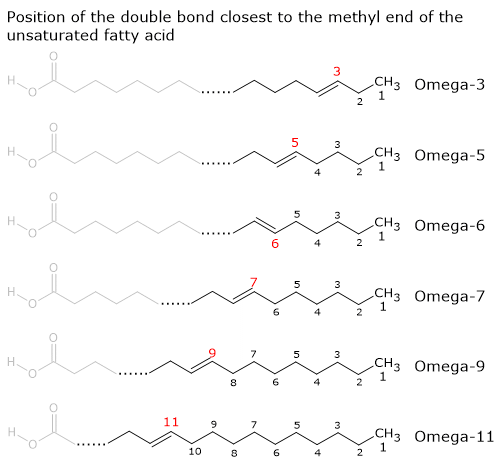
In the human diet, the most important categories are Omega-3, Omega-6, and Omega-9. When including the Omega-7 family, these encompass virtually all unsaturated fatty acids encountered in a standard diet.
Esterified and non-esterified fatty acids
The vast majority of fatty acids found in the body do not exist in an unesterified free form, since they are potentially toxic or detergent-like, but are bound via ester bonds to other molecules: to glycerol-3-phosphate, to form phospholipids, the primary non-protein constituents of cell membranes, to glycerol, to form triacylglycerols, and to sterols, to form the corresponding esters.
Generally, in cell membranes, unsaturated fatty acids are found in the sn-2 position of phospholipids and have 18 to 20 carbon atoms. In the sn-1 position, saturated fatty acids with 16 to 18 carbon atoms are more commonly present.
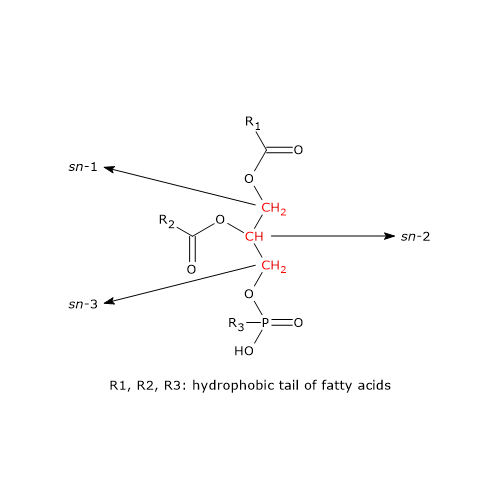
In triacylglycerols, monounsaturated and long-chain saturated fatty acids tend to occupy the sn-1 and sn-3 positions, while polyunsaturated fatty acids occupy the sn-2 position. In particular, oleic and linoleic acids, together with palmitic acid, a saturated fatty acid, are by far the three most abundant fatty acids in the triacylglycerols of adipose tissue and plasma lipoproteins.
The small percentage of fatty acids present in the bloodstream in free form, referred to as FFA or NEFA, standing for free fatty acids and non-esterified fatty acids, respectively, are derived from lipolysis and are almost entirely bound to albumin.
Energy role
The fatty acids present in triglycerides represent the cell’s primary energy reserve. Due to the high degree of reduction of their carbon atoms, once released from triacylglycerols and aerobically oxidized via β-oxidation, they provide an average of 9 kcal/g (37.6 kJ/g), more than twice that of carbohydrates and proteins.
Biochemical note: for the same number of carbon atoms, the presence of unsaturation slightly reduces the molecule’s hydrogen content, resulting in a slightly lower ATP yield compared to the corresponding saturated fatty acids. For example, if we compare stearic acid, an 18-carbon saturated fatty acid, and oleic acid, an 18-carbon monounsaturated fatty acid, the former generates approximately 122 ATP, while the latter generates approximately 120.5 ATP: a difference of 1.23%. This is why, from a nutritional standpoint, the energy yield per gram is approximated at 9 kcal/g for all fatty acids.
Structural and biological roles
As components of phospholipids, fatty acids directly influence the architecture of cell membranes. Unlike proteins or complex carbohydrates, whose building blocks are broken down and resynthesized, fatty acids obtained from the diet are incorporated directly, as they are, into the phospholipid matrix.
Their chemical and physical properties govern cellular function in two main ways.
- Fluidity and lipid rafts: the curvature of the carbon chain imposed by the presence of cis double bonds creates a structure that, by preventing tight packing between adjacent chains, increases membrane fluidity. In contrast, regions rich in linear saturated fats, trans fats, and cholesterol tend to form stiffer microdomains known as lipid rafts, which serve as essential platforms for housing signaling proteins and receptors.
- Inflammatory and immune response: 20-carbon PUFAs present at the sn-2 position of phospholipids, such as arachidonic and eicosapentaenoic acids, serve as precursors for the synthesis of eicosanoids, namely, prostaglandins, thromboxanes, and leukotrienes. The release of these bioactive lipid mediators modulates inflammatory processes, blood pressure, and blood clotting.
In addition to their structural role and function as a reservoir for inflammatory mediators, some free unsaturated fatty acids act directly as hormonal signaling molecules, known as lipokines. This is the case with palmitoleic acid, which is released by adipose tissue to improve and stimulate insulin sensitivity in the liver and muscles.
References
- Akoh C.C., Min D.B. Food lipids: chimistry, nutrition, and biotechnology. 4th Edition. Boca Raton: CRC Press, 2017. doi:10.1201/9781315151854
- Alberts B., Johnson A., Lewis J., Morgan D., Raff M., Roberts K., Walter P. Molecular biology of the cell. 7th Edition. Garland Science, Taylor & Francis Group, 2022.
- Cao H., Gerhold K., Mayers J.R., Wiest M.M., Watkins S.M., Hotamisligil G.S. Identification of a lipokine, a lipid hormone linking adipose tissue to systemic metabolism. Cell 2008; 134:933-944. doi:10.1016/j.cell.2008.07.048
- Chow Ching K. Fatty acids in foods and their health implication. 3rd Edition. CRC Press, Taylor & Francis Group, 2008.
- Guyton A.C., Hall J.E. Textbook of medical physiology. 14th Edition. Philadelphia: Elsevier, 2021.
- Olefsky J.M. Fat Talks, Liver and Muscle Listen. Cell 2008; 134:914-916. doi:10.1016/j.cell.2008.09.001
- Soderberg T. Organic chemistry with a biological emphasis. Volume I. Chemistry Publications. 2019.
- Solomons T.W.G., Fryhle C.B., Snyder S.A. Solomons’ organic chemistry. 12th Edition. John Wiley & Sons Incorporated, 2017.
- Stipanuk M.H., Caudill M.A. Biochemical, physiological, and molecular aspects of human nutrition. 4th Edition. St. Louis: Elsevier, 2018.
Domande Frequenti
What is the difference between cis and trans unsaturated fatty acids?
In cis isomers, the carbon chain enters and exits on the same side of the double bond, bending the molecule and increasing membrane fluidity. In trans isomers, they are on opposite sides: the chain remains straight, showing physical and chemical properties similar to saturated fats.
Why do unsaturated fatty acids have lower melting points than saturated?
The molecular kink caused by cis double bonds prevents tight structural packing. This structural disruption weakens interchain hydrophobic interactions, meaning less thermal energy is required to separate the lipid molecules and change their state from solid to liquid.
Which oils should be avoided during high-heat cooking and why?
Oils high in polyunsaturated fatty acids, such as soy, corn, and sunflower, must be avoided. Their double bonds create highly reactive allylic and bis-allylic hydrogens, making them prone to rapid lipid peroxidation under heat and light, generating toxic compounds.