Saturated fatty acids are a class of fatty acids whose carbon chain contains no double or triple bonds, consisting only of single carbon-carbon bonds.
They have the general formula R–COOH, where the R– group is a chain of carbon atoms, also known as a hydrocarbon chain, that is generally linear and of variable length. Based on chain length, four classes of fatty acids can be identified, which also include the saturated fatty acids most commonly found in foods, the subject of this article.
The length of the hydrocarbon chain also influences the physicochemical properties of saturated fatty acids, and the absence of double bonds ensures their resistance to oxidation.
For a complete list of the most common saturated, monounsaturated, and polyunsaturated fatty acids found in the diet, please refer to the list of fatty acids page.
Summary: Key Points
- Structure and classification: linear molecules with only single carbon-carbon bonds. Based on chain length, they are divided into four classes: short-, medium-, long-, and very-long-chain fatty acids.
- Physicochemical properties: their straight-chain conformation allows tight intermolecular packing. As chain length increases, hydrophobicity, melting points, and boiling points increase, remaining higher than those of their unsaturated counterparts.
- Chemical inertness and stability: the lack of double bonds eliminates highly reactive allylic hydrogens, making them exceptionally resistant to oxidation, light, and heat, and thus ideal for high-temperature cooking.
- Molecular state and absorption: they are primarily found esterified within triglycerides and phospholipids.
- Energy and biological roles: they yield approximately 9 kcal/g. They modulate membrane fluidity and serve as lipid anchors for proteins.
Contents
- Carbon chain length
- Physicochemical properties
- Oxidative stability
- Esterified and non-esterified fatty acids
- Energy roles
- Structural and biological roles
- References
Carbon chain length
The carbon chain of saturated fatty acids is generally unbranched, contains an even number of carbon atoms, and has the formula CH3(CH2)n.
They range from short-chain fatty acids (SCFA), with two to five carbon atoms, to fatty acids with chains consisting of 30 or more carbon atoms.
Based on chain length, fatty acids can be divided into four classes: short-chain fatty acids, medium-chain fatty acids (MCFA) with 6 to 12 carbon atoms, long-chain fatty acids (LCFA) with 13 to 21 carbon atoms, and very long-chain fatty acids (VLCFA) with 22 or more carbon atoms. All eleven saturated fatty acids most commonly found in foods can be classified into one of the four classes mentioned above, as shown in the table below.
The fatty acids most commonly found in foods have chains of 12–22 carbon atoms, and the most widely consumed are myristic acid, palmitic acid, and stearic acid.
| Class | Length | Common name | IUPAC name | Shorthand |
|---|---|---|---|---|
| SCFA | C2–C5 | Butyric acid | Butanoic acid | 4:0 |
| MCFA | C6–C12 | Caproic acid | Hexanoic acid | 6:0 |
| Caprylic acid | Octanoic acid | 8:0 | ||
| Capric acid | Decanoic acid | 10:0 | ||
| Lauric acid | Dodecanoic acid | 12:0 | ||
| LCFA | C13–C21 | Myristic acid | Tetradecanoic acid | 14:0 |
| Palmitic acid | Hexadecanoic acid | 16:0 | ||
| Stearic acid | Octadecanoic acid | 18:0 | ||
| Arachidic acid | Eicosanoic acid | 20:0 | ||
| VLCFA | ≥ C22 | Behenic acid | Docosanoic acid | 22:0 |
| Lignoceric acid | Tetracosanoic acid | 24:0 |
Physicochemical properties
The hydrocarbon chain of saturated fatty acids, and, more generally, of all fatty acids, profoundly influences the physicochemical properties of the molecule, such as hydrophobicity, melting and boiling points, and stability to oxidation, and consequently also its biological effects.
As the chain length increases, so does hydrophobicity, which ultimately overcomes the polarity of the carboxyl group, making the molecules insoluble in water (or in polar solvents). Consequently, the melting and boiling points increase as the chain length and molecular weight increase.
From a physicochemical perspective, the increase in melting and boiling points is a consequence of the linear conformation of the saturated hydrocarbon chains. This allows for their packing and the consequent formation of many interchain hydrophobic bonds that stabilize the structure. Therefore, more energy is required to separate the molecules, resulting in higher thermal transition temperatures compared to their unsaturated counterparts.
Oxidative stability
The stability of saturated fatty acids against oxidation, that is, against attack by oxygen, stems from the absence of double or triple bonds in the carbon chain. In fact, unlike unsaturated fatty acids, both monounsaturated and polyunsaturated, the exclusive presence of single bonds means there are no attachment points for oxygen, namely the hydrogen atoms adjacent to double bonds, those in the allylic position, which are highly reactive and easily removed by the oxidizing agent. This makes saturated fatty acids resistant even to the effects of light and heat.
The practical implication of this chemical inertness is reflected in the choice of fats for cooking methods that require high temperatures, such as deep-frying. To prevent the formation of toxic compounds, oils and fats with a high percentage of saturated fatty acids in their triacylglycerols should be preferred, such as coconut oil, or, among animal fats, lard or clarified butter.
Note: peanut oil is also an excellent oil for frying. However, its stability does not stem from a high content of saturated fatty acids, but rather from its high content of monounsaturated fatty acids (similar to olive oil) and its high smoke point.
Esterified and non-esterified fatty acids
Most saturated fatty acids, and, more generally, all fatty acids present in the body, are not in free form, as they are potentially toxic molecules; instead, they are bound via an ester bond to molecules such as glycerol, forming triacylglycerols, to glycerol 3-phosphate to form phospholipids, and to sterol esters, such as cholesterol esters.
Generally, in membranes, saturated fatty acids are bound at the sn-1 position of phospholipids and have 16 to 18 carbon atoms. At the sn-2 position, unsaturated fatty acids with 18 to 20 carbon atoms are often present.
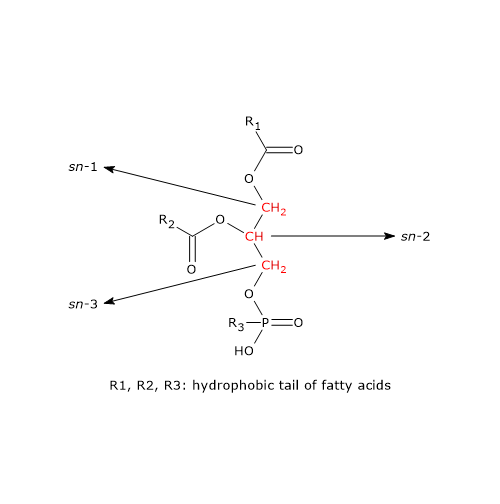
In triacylglycerols, saturated fatty acids, often long-chain ones, and monounsaturated fatty acids tend to be at the sn-1 and sn-3 positions, while polyunsaturated fatty acids are found at the sn-2 position.
Palmitic acid in human and bovine milk triacylglycerols, unlike in most triacylglycerols found in vegetable fats, is preferentially located at the sn-2 position. This configuration dramatically increases its intestinal absorption, since pancreatic lipases hydrolyze the sn-1 and sn-3 bonds, leaving palmitate as a 2-monoglyceride, which is easily absorbed without forming insoluble soaps with calcium.
The small percentage of fatty acids present in free form, referred to as NEFA (non-esterified fatty acids) and FFA (free fatty acids), respectively, is derived from lipolysis, and in the bloodstream, almost all of it is bound to albumin.
Energy roles
Saturated fatty acids, thanks to the highly reduced state of their carbon chains, represent a rich source of energy for the cell. Once released from triacylglycerols, they can be aerobically oxidized and provide approximately 9 kcal/g, more than double the energy obtained from the aerobic oxidation of proteins and carbohydrates.
It should be noted, however, that the oxidation of short-chain fatty acids yields lower amounts of energy; in the context of human nutrition, therefore, the focus is almost exclusively on butyric acid (6.0 kcal/g).
The primary sites of fatty acid oxidation are the liver, skeletal muscle, and the heart.
Medium-chain fatty acids, much like their short-chain counterparts such as butyric acid, differ from long-chain and very long-chain fatty acids in certain metabolic properties: they do not require the carnitine transport system to enter the mitochondria and are not incorporated into chylomicrons. Instead, they are absorbed directly into the portal circulation and sent to the liver for rapid β-oxidation. This is why they have a strong ketogenic effect and are widely used in clinical and sports nutrition.
Structural and biological roles
Fatty acids play an important structural role, as they are components of phospholipids, which in turn are fundamental constituents of cell membranes. Crucially, unlike proteins and nucleic acids, they can be incorporated intact, with consequent changes in cell functionality and permeability. In fact, when considering saturated fatty acids, which are relatively linear molecules, an increase in their levels at the expense of monounsaturated and polyunsaturated fatty acids can lead to a reduction in membrane fluidity, altering its structural stability.
Many saturated fatty acids, particularly palmitic and myristic acids, form covalent bonds with specific cellular proteins. This bond acts as a lipid anchor, through processes such as palmitoylation and myristoylation, allowing the proteins to position themselves correctly on the membranes to perform cellular signaling functions.
References
- Akoh C.C., Min D.B. Food lipids: chemistry, nutrition, and biotechnology. 4th Edition. Boca Raton: CRC Press, 2017. doi:10.1201/9781315151854
- Alberts B., Johnson A., Lewis J., Morgan D., Raff M., Roberts K., Walter P. Molecular biology of the cell. 7th Edition. Garland Science, Taylor & Francis Group, 2022.
- Chow Ching K. Fatty acids in foods and their health implication. 3rd Edition. CRC Press, Taylor & Francis Group, 2008.
- Guyton A.C., Hall J.E. Textbook of medical physiology. 14th Edition. Philadelphia: Elsevier, 2021.
- Heilman D., Woski S., Voet D., Voet J.G., Pratt C.W. Fundamentals of biochemistry: life at the molecular level. 6th Edition. Wiley, 2023.
- Soderberg T. Organic chemistry with a biological emphasis. Volume I. Chemistry Publications. 2019.
- Solomons T.W.G., Fryhle C.B., Snyder S.A. Solomons’ organic chemistry. 12th Edition. John Wiley & Sons Incorporated, 2017.
- Stipanuk M.H., Caudill M.A. Biochemical, physiological, and molecular aspects of human nutrition. 4th Edition. St. Louis: Elsevier, 2018.
Domande Frequenti
What exactly makes a fatty acid saturated from a chemical perspective?
A fatty acid is saturated when its hydrocarbon chain completely lacks double or triple bonds. The carbon atoms are linked solely by single covalent bonds and hold the maximum number of hydrogen atoms, resulting in a highly stable, linear molecular structure that impacts its properties.
Why are saturated fatty acids ideal for frying and high-heat cooking?
The absence of double bonds eliminates highly reactive allylic hydrogen atoms. This chemical inertness makes saturated fats exceptionally resistant to oxidation triggered by heat and light, effectively preventing thermal degradation and the formation of toxic compounds during cooking.
How are dietary saturated fatty acids classified in human nutrition?
They are categorized into four distinct biological classes based on their carbon chain length: short-chain (SCFA), medium-chain (MCFA), long-chain (LCFA), and very-long-chain (VLCFA). This classification directly dictates their metabolic pathways, rate of absorption, and energy yield.