In 1906, Russian-American chemist Martin André Rosanoff, then working at New York University, selected glyceraldehyde, a simple monosaccharide, as the standard for designating the stereochemistry of molecules with at least one chiral center, such as carbohydrates. This nomenclature system became known as the Fischer-Rosanoff convention (or simply the D-L system).[1]
Summary: Key Points:
- Relative configuration: the Fischer-Rosanoff convention (D-L system) determines the relative spatial orientation of carbohydrates and amino acids using glyceraldehyde as an arbitrary standard.
- Optical independence: there is no direct correlation between the D/L stereochemical prefixes (configuration) and the (+)/(–) signs indicating the direction of optical rotation.
- Assignment rules: the classification is determined by the asymmetric carbon farthest from the carbonyl group in monosaccharides, and by the asymmetric α-carbon in amino acids.
- Structural limitations: the system specifies only the geometry of the reference carbon; ambiguities in molecules with multiple chiral centers were resolved in 1956 by the RS absolute nomenclature.
Contents
- Fischer-Rosanoff convention: origin and application
- Fischer-Rosanoff convention: carbohydrates
- Fischer-Rosanoff convention: α-amino acids
- Relative and absolute configurations
- Ambiguities of the Fischer-Rosanoff convention
- References
Fischer-Rosanoff convention: origin and application
Since the absolute configuration of glyceraldehyde was unknown at the time, Rosanoff assigned the stereochemistry in an entirely arbitrary way:
- The D prefix (from the Latin dexter, meaning “right”) was assigned to (+)-glyceraldehyde, the dextrorotatory enantiomer, assuming that, in its Fischer projection, the hydroxyl group (–OH) was on the right side of the chiral center.
- The L prefix (from the Latin laevus, meaning “left”) was assigned to (−)-glyceraldehyde, the levorotatory enantiomer, assuming the hydroxyl group was on the left side of the chiral center.[2]
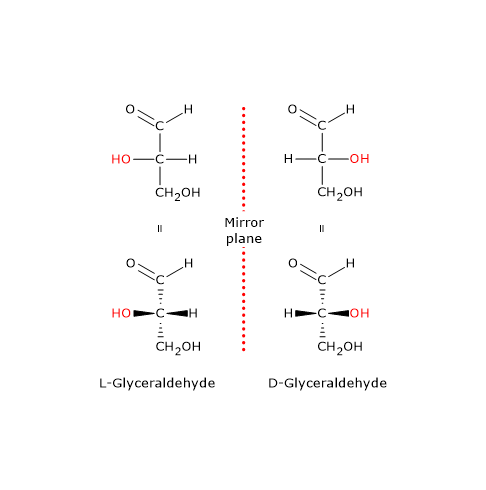
Although Emil Fischer himself rejected this system, it was widely adopted for determining the relative configurations of chiral molecules. This was achieved by chemically converting a molecule into a derivative of glyceraldehyde using reactions that retain the configuration, meaning no bonds to the chiral center are broken; the spatial arrangement around the chiral center is preserved.[3]
The Fischer-Rosanoff convention allows chemists to classify chiral molecules, such as amino acids and monosaccharides, into two categories: the D series and the L series, depending on whether their configuration corresponds to that of D- or L-glyceraldehyde.
Note: there is no direct correlation between configuration (D or L) and the direction of optical rotation. The D–L system does not indicate whether a molecule is dextrorotatory or levorotatory; it only relates molecular configuration to that of glyceraldehyde.[4]
Fischer-Rosanoff convention: carbohydrates
Monosaccharides can be classified as either aldoses or ketoses. Aldoses, and ketoses with more than three carbon atoms, have at least one chiral center. By convention, they are assigned to the D or L series depending on the configuration of the chiral carbon farthest from the carbonyl group (the carbon with the highest oxidation state, from which numbering begins). If this configuration matches that of D-glyceraldehyde or L-glyceraldehyde, the molecule is placed in the corresponding D or L series.
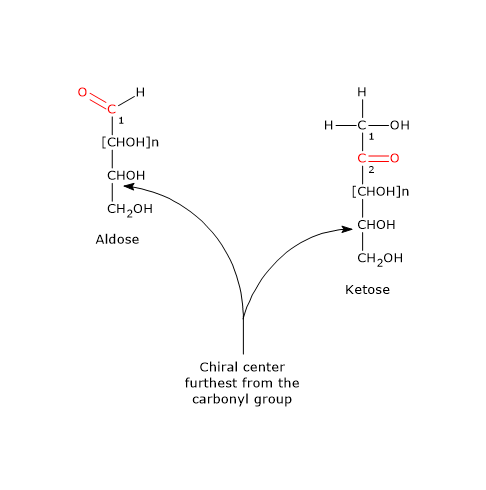
In Fischer projections, the longest carbon chain is drawn vertically, and the carbon atoms are numbered so that the carbonyl carbon receives the lowest possible number: C-1 in aldoses and C-2 in ketoses.[5]
Note: in nature, D-sugars are far more common than L-sugars.
When it is necessary to specify the optical rotation of a monosaccharide, the prefixes (+) or (–) can be added to the D or L designation. For example, fructose, which is levorotatory, can be written as D-(–)-fructose, whereas glucose, which is dextrorotatory, can be written as D-(+)-glucose.
Fischer-Rosanoff convention: α-amino acids
Amino acids can be classified based on the position of the amino group (–NH2) relative to the carboxyl group (–COOH):
- α-amino acids: the amino group is attached to the α-carbon;
- β-amino acids: the amino group is attached to the β-carbon;
- γ-amino acids: the amino group is attached to the γ-carbon;
- δ-amino acids: the amino group is attached to the δ-carbon.
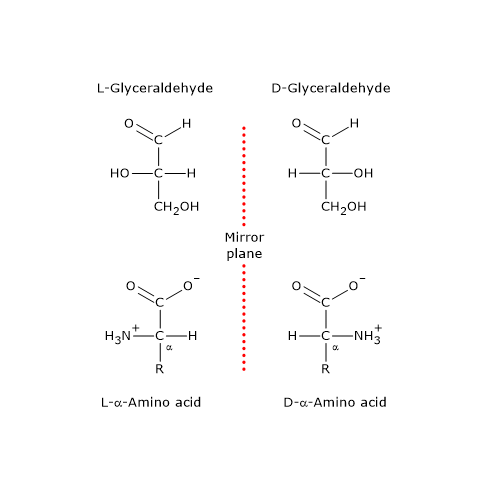
α-Amino acids are assigned to the D or L series based on the configuration of the four groups attached to the α-carbon, the chiral center: –NH2, –COOH, –R, and –H. If their spatial arrangement matches that of the hydroxyl, aldehyde (–CHO), hydroxymethyl (–CH2OH), and hydrogen atoms in D- or L-glyceraldehyde, the amino acid belongs to the corresponding series.[4]
In Fischer projections, amino acids are represented with the carboxyl group, the carbon with the highest oxidation state, at the top, and the R group at the bottom.
Among α-amino acids, the proteinogenic amino acids (those involved in protein synthesis), with the exception of glycine, whose α-carbon is not chiral, all exhibit the L configuration, and are thus known as L-α-amino acids.
Note: in nature, L-α-amino acids are significantly more abundant than other types of amino acids, which do not participate in protein synthesis.[5]
Relative and absolute configurations
When Rosanoff arbitrarily assigned the D prefix to (+)-glyceraldehyde and the L prefix to (–)-glyceraldehyde, he had a 50/50 chance of being correct.[6]
In the early 1950s, the development of X-ray diffraction analysis made it possible to determine the absolute configuration of chiral molecules. In 1951, Dutch chemist Johannes Martin Bijvoet established the absolute configuration of sodium rubidium (+)-tartrate tetrahydrate. By comparing it with glyceraldehyde, he demonstrated that Rosanoff’s assumption was correct.
As a result, the configurations of chiral compounds previously assigned relative to glyceraldehyde turned out to match their true absolute configurations, thereby converting these relative configurations into absolute ones.[7]
Ambiguities of the Fischer-Rosanoff convention
The Fischer-Rosanoff convention can lead to ambiguities when applied to molecules with more than one chiral center. For example, in D-(+)-glucose, the D–L system provides information only about the configuration at C-2, but gives no indication regarding the other chiral centers, namely C-3, C-4, and C-5.[3]
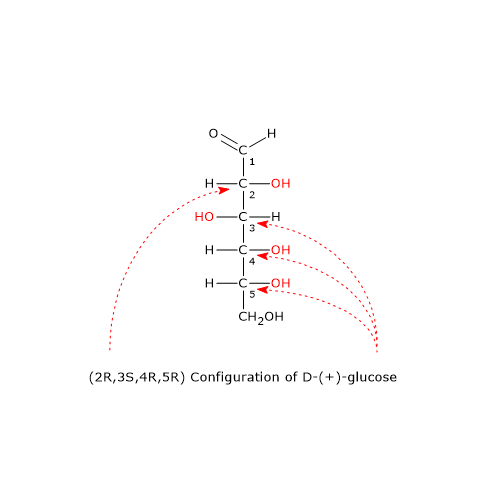
In such cases, the RS system, developed in 1956 by Robert Sidney Cahn, Christopher Ingold, and Vladimir Prelog, offers a more precise description by assigning a configuration to each chiral center individually. For instance, D-(+)-glucose has the configuration (2R,3S,4R,5R).[5][8]
It should also be noted that the D or L designation depends on which chiral center is chosen as the reference point. Consequently, the same molecule can sometimes be classified as either D or L, depending on the structural context.
References
- ^ Rosanoff M.A. On Fischer’s classification of stereo-isomers. J Am Chem Soc 1906:28(1);114-121. doi:10.1021/ja01967a014
- ^ IUPAC. Compendium of Chemical Terminology, 2nd ed. (the “Gold Book”). Compiled by A. D. McNaught and A. Wilkinson. Blackwell Scientific Publications, Oxford (1997). Online version (2019-) created by S. J. Chalk. ISBN 0-9678550-9-8. doi:10.1351/goldbook
- ^ a b Garrett R.H., Grisham C.M. Biochemistry. 7th Edition. Cengage Learning, 2023.
- ^ a b Nelson D.L., Cox M.M. Lehninger. Principles of biochemistry. 8th Edition. W.H. Freeman and Company, 2021.
- ^ a b c Heilman D., Woski S., Voet D., Voet J.G., Pratt C.W. Fundamentals of biochemistry: life at the molecular level. 6th Edition. Wiley, 2023.
- ^ Moran L.A., Horton H.R., Scrimgeour K.G., Perry M.D. Principles of Biochemistry. 5th Edition. Pearson, 2012.
- ^ Bijvoet J.M., Peerdeman A.F., Van Bommel A.J. Determination of the absolute configuration of optically active compounds by means of X-rays. Nature 1951;168(4268):271. doi:10.1038/168271a0
- ^ Cahn R.S., Ingold C., Prelog V. Specification of molecular chirality. Angew Chem 1966:5(4); 385-415. doi:10.1002/anie.196603851
Domande Frequenti
What is the Fischer-Rosanoff convention or D-L system?
It is a stereochemical nomenclature system that classifies chiral molecules like carbohydrates and amino acids into two series (D or L). It relies on comparing their relative configuration to that of glyceraldehyde, which was chosen as the standard reference molecule.
Is there a link between D-L configuration and optical rotation?
No, there is no direct correlation. The D and L prefixes indicate only the spatial arrangement of groups relative to glyceraldehyde. The direction of polarized light rotation is a separate physical property denoted strictly by using the (+) or (-) signs.
How is the D or L series assigned to sugars and amino acids?
In carbohydrates, it depends on the configuration of the chiral carbon farthest from the carbonyl group. In α-amino acids, it is determined by the arrangement of the four groups bound to the asymmetric α-carbon, where the L-configuration heavily dominates in nature.
What are the main limits of the Fischer-Rosanoff convention?
The D-L system creates ambiguity in molecules with multiple stereocenters because it defines global configuration using a single reference carbon. To map each chiral center individually and absolute, the RS (CIP) priority ruleset was introduced in 1956.