Substrate-level phosphorylation is defined as the production of ATP or GTP following the transfer of a phosphate group from a substrate to ADP or GDP.[1]
The energy released from the cleavage of a high-energy bond of the substrate facilitates the formation of the phosphoanhydride bond.[2] Part of this energy drives the reaction toward nucleotide triphosphate formation, while the remainder is stored in the newly formed bond.[3]
This process involves soluble enzymes and chemical intermediates, differing from oxidative phosphorylation and photophosphorylation, which rely on membrane-bound enzymes and transmembrane proton gradients.[2]
Examples of substrate-level phosphorylation are found in the glycolytic pathway and the citric acid cycle.[3]
Although under aerobic conditions most ATP is produced by oxidative phosphorylation and by photophosphorylation in photosynthetic organisms, substrate-level phosphorylation remains essential in energy metabolism, particularly under anaerobic conditions.[4][5]
Summary: Key Points
- Definition: the direct production of ATP or GTP by transferring a high-energy phosphate group from a metabolic substrate to ADP or GDP.
- Mechanism: driven by the cleavage of high-energy chemical bonds; it uses soluble enzymes and occurs independently of proton gradients or membrane-bound complexes.
- Metabolic pathways: occurs in glycolysis (reactions catalyzed by phosphoglycerate kinase and pyruvate kinase) and the citric acid cycle (reaction catalyzed by succinyl-CoA synthetase).
- Biological significance: essential for energy metabolism, it is the primary mechanism for ATP synthesis under anaerobic conditions.
Contents
Glycolysis and ADP phosphorylation
Two well-known examples of substrate-level phosphorylation occur in glycolysis.
During the energy recovery phase of glycolysis, two of the five reactions directly extract and store chemical energy from metabolic intermediates as ATP.[5]
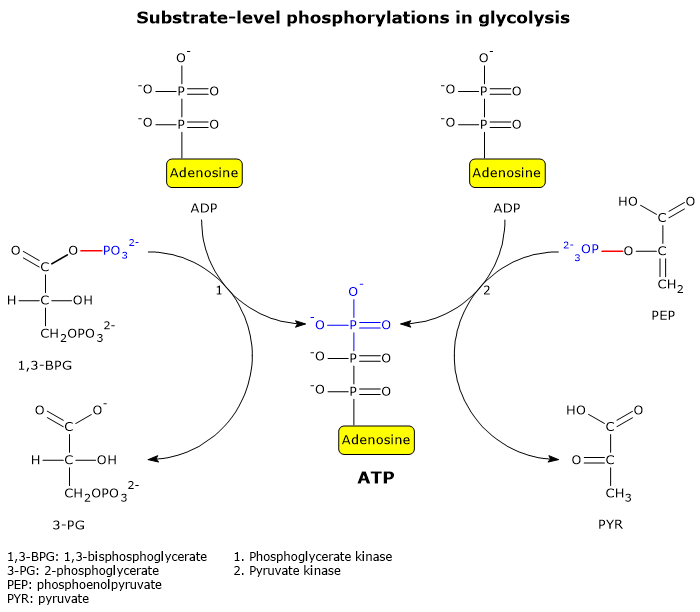 These reactions are catalyzed by phosphoglycerate kinase (EC 2.7.2.3) and pyruvate kinase (EC 2.7.1.40).
In these reactions, a high-energy phosphate group is transferred to ADP from the following substrates:
- 1,3-bisphosphoglycerate, resulting in the production of ATP and 3-phosphoglycerate;
- phosphoenolpyruvate, resulting in the production of ATP and pyruvate.[6]
These two glycolytic substrate-level phosphorylation reactions enable ATP synthesis even under anaerobic conditions.[3]
The citric acid cycle and GDP phosphorylation
Another example of substrate-level phosphorylation occurs in the reaction of the citric acid cycle catalyzed by succinyl-CoA synthetase, also known as succinate-CoA ligase (EC 6.2.1.4). This enzyme catalyzes the cleavage of the high-energy thioester bond in succinyl-CoA, similar to that in acetyl-CoA. The energy released drives the formation of a phosphoanhydride bond, leading to the conversion of GDP to GTP.[5]
| Pathway | Enzyme | EC Number | Reaction Details |
|---|---|---|---|
| Glycolysis | Phosphoglycerate kinase | EC 2.7.2.3 | Transfers a high-energy phosphate group from 1,3-bisphosphoglycerate to ADP, producing 3-phosphoglycerate and ATP |
| Pyruvate kinase | EC 2.7.1.40 | Transfers a high-energy phosphate group from phosphoenolpyruvate (PEP) to ADP, producing pyruvate and ATP | |
| Citric acid cycle | Succinyl-CoA synthetase | EC 6.2.1.4 | Cleaves the high-energy thioester bond of succinyl-CoA to drive the phosphorylation of GDP to GTP (or ADP to ATP) |
References
- ^ Ha C.E., Bhagavan N.V. Chapter 11 – Carbohydrate metabolism I: glycolysis and the tricarboxylic acid cycle. Editor(s): Chung Eun Ha, N.V. Bhagavan. Essentials of Medical Biochemistry. 3rd Edition. Academic Press, 2023, pages 203-227. doi:10.1016/B978-0-323-88541-6.00030-2
- a b Garrett R.H., Grisham C.M. Biochemistry. 7th Edition. Cengage Learning, 2023.
- a b c Nelson D.L., Cox M.M. Lehninger Principles of Biochemistry. 8th Edition. W.H. Freeman and Company, 2021.
- ^ Michal G., Schomburg D. Biochemical Pathways: An Atlas of Biochemistry and Molecular Biology. 2nd Edition. John Wiley & Sons, Inc., 2012.
- a b c Heilman D., Woski S., Voet D., Voet J.G., Pratt C.W. Fundamentals of Biochemistry: Life at the Molecular Level. 6th Edition. Wiley, 2023.
- ^ Moran L.A., Horton H.R., Scrimgeour K.G., Perry M.D. Principles of Biochemistry. 5th Edition. Pearson, 2012.
Domande Frequenti
What is the main difference from oxidative phosphorylation?
Substrate-level phosphorylation occurs via the direct transfer of a phosphate group from a high-energy intermediate to ADP or GDP using soluble enzymes. Unlike oxidative phosphorylation, it does not require a membrane-bound electron transport chain, oxygen, or a transmembrane proton gradient.
Where does substrate-level phosphorylation occur in the cell?
This process takes place within the cytoplasm during glycolysis and inside the mitochondrial matrix during the citric acid cycle. It involves soluble enzymes like pyruvate kinase and succinyl-CoA synthetase, making it independent of the inner mitochondrial membrane structures.
Why is this process critical for anaerobic metabolism?
Under anaerobic conditions, the lack of oxygen halts oxidative phosphorylation. Substrate-level phosphorylation serves as the primary mechanism for ATP production, allowing cells to maintain energy homeostasis and survive through pathways like fermentation and anaerobic glycolysis.
Which enzymes catalyze these high-energy phosphate transfers?
The key enzymes include phosphoglycerate kinase and pyruvate kinase during the payoff phase of glycolysis, and succinyl-CoA synthetase (succinate-CoA ligase) in the citric acid cycle. These enzymes facilitate the energy coupling required to form phosphoanhydride bonds in ATP or GTP.
What substrates act as phosphate donors in these reactions?
The primary high-energy donors are 1,3-bisphosphoglycerate and phosphoenolpyruvate in glycolysis, and succinyl-CoA in the citric acid cycle. The cleavage of their high-energy thioester or phosphate bonds releases the necessary Gibbs free energy to drive the synthesis of nucleotide triphosphates.