Anti-caking agents are additives used in the production of powdered or dried foods to prevent aggregation and, consequently, the formation of lumps.[1][2]
Lump formation can be caused by the presence of hygroscopic compounds in food, which tend to absorb water vapor from the atmosphere, and/or by lipids that may bind together.[3]
Their use is also essential in the processing of foods made from powdered ingredients. Without them, lumps could form in the conduits of machines such as dough mixers. This problem may also occur in vending machines that dispense milk-based drinks, coffee, sugar, or cocoa.[4][5]
The most common anti-caking agents include inorganic salts such as carbonates, phosphates, and silicates.[6]
Anti-caking agents operate through three distinct modes of action. First, they absorb excess moisture by selectively binding water molecules, preventing any interaction with potential hygroscopic substances. Second, these additives render the surfaces of fatty foods water-repellent by creating a protective hydrophobic film. Finally, they inhibit the physical aggregation of lipids.[4][7]
Summary: Key Points
- Definition and function: anti-caking agents are food additives used in the production of powdered or dried products to prevent aggregation and lump formation, ensuring the solubility and appearance of the food.
- Modes of action: they work by absorbing excess moisture, rendering fat surfaces water-repellent, and inhibiting lipid aggregation.
- Industrial applications: their use is essential both for product quality and for the proper functioning of machinery and vending machines.
- Regulation and safety: identified also through the E-number system, anti-caking agents authorized in the European Union are evaluated by competent authorities and considered safe for human health when used according to specific guidelines.
Contents
Foods they are added to
They are added to foods such as cocoa, powdered milk, icing sugar, table salt, flavorings like onion or garlic powder mixed with salt, grated cheese, cake mixes, baking powder, powdered eggs, instant coffee, powdered supplements, and tablets.[8]
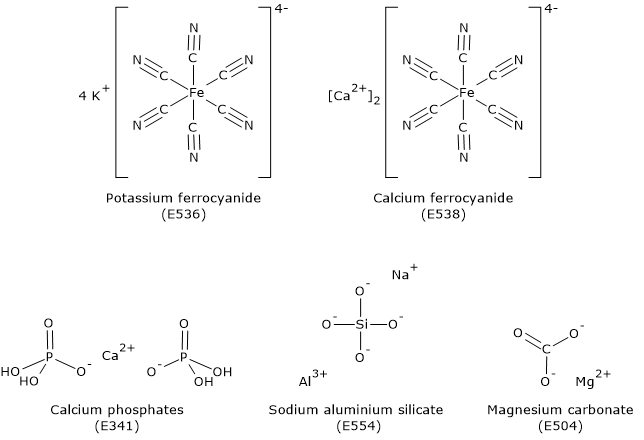
Like other food additives, anti-caking agents are identified not only by their name but also by their E-numbers, where “E” stands for Europe.[9] Since a wide variety of processed foods can form lumps, one or more specific anti-caking agents are used for each type of food.
Examples of anti-caking agents
Below is a brief overview of some anti-caking agents included in the list of food additives authorized for use in the European Union, according to Regulation (EU) No. 1129/2011 of the European Commission, published on 11 November 2011. This list amended Annex II of Regulation (EC) No. 1333/2008 of the European Parliament and was itself amended again in 2013.[10]
| E-number | Additive |
|---|---|
| E170 | Calcium carbonate |
| E341 | Calcium phosphates |
| E460 | Cellulose |
| E504 | Magnesium carbonate |
| E535 | Sodium ferrocyanide |
| E536 | Potassium ferrocyanide |
| E538 | Calcium ferrocyanide |
| E551 | Silicon dioxide |
| E552 | Calcium silicate |
| E553a | Magnesium silicate |
| E553b | Talc |
| E554 | Sodium aluminium silicate |
| E555 | Potassium aluminium silicate |
| E556 | Calcium aluminium silicate |
Health effects
The safety of foods containing anti-caking agents is evaluated, as with all other food additives, by the competent authorities, whose decisions are based on the scientific literature available at the time of the assessment. Based on current evidence, anti-caking agents, when used in accordance with specific guidelines, are considered safe for human health.[11][12]
References
- a b Belitz H.-D., Grosch W., Schieberle P. Food Chemistry. 4th Edition. Springer, 2009.
- ^ Fu Y., Luo F., Ma L., Dai H., Wang H., Chen H., Zhu H., Yu Y., Hou Y., Zhang Y. The moisture adsorption, caking, and flowability of silkworm pupae peptide powders: the impacts of anticaking agents. Food Chem 2023;419:135989. doi:10.1016/j.foodchem.2023.135989
- ^ Chen M., Wu S., Xu S., Yu B., Shilbayeh M., Liu Y., Zhu X., Wang J., Gong J. Caking of crystals: characterization, mechanisms and prevention. Powder Technol 2018:337;51-67. doi:10.1016/j.powtec.2016.12.015
- a b Fattinonfake.federchimica.it. Niente grumi… grazie agli antiagglomeranti. 7 ottobre 2021.
- ^ Ueda J.M., Morales P., Fernández-Ruiz V., Ferreira A., Barros L., Carocho M., Heleno S.A. Powdered foods: structure, processing, and challenges: a review. Appl Sci 2023;13(22):12496. doi:10.3390/app132212496
- ^ Bender D.A. Benders’ Dictionary of Nutrition and Food Technology. 8th Edition. Woodhead Publishing. Oxford, 2006
- ^ Pui L.P., Saleena L.A.K., Ghazali H.M. Storage stability and anti-caking agents in spray-dried fruit powders: a review. Food Mater Res 2024;12(2):229-239. doi:10.21603/2308-4057-2024-2-603
- ^ Damodaran S., Parkin K. Fennema’s Food Chemistry. 5th Edition. CRC Press, 2017. doi:10.1201/9781315372914
- ^ Food Standards Agency. Approved additives and E Numbers. Last updated: 16 July 2025.
- ^ Commission Regulation (EU) No 1129/2011 of 11 November 2011 amending Annex II to Regulation (EC) No 1333/2008 of the European Parliament and of the Council by establishing a Union list of food additives. https://eur-lex.europa.eu/eli/reg/2011/1129/2013-11-21
- ^ EFSA FAF Panel (EFSA Panel on Food Additives and Flavourings), Younes M., Aquilina G., Castle L., et al. Re-evaluation of silicon dioxide (E 551) as a food additive in foods for infants below 16 weeks of age and follow-up of its re-evaluation as a food additive for uses in foods for all population groups. EFSA Journal 2024;22(10):e8880. doi:10.2903/j.efsa.2024.8880
- ^ EFSA Food additives. Last reviewed date: 18 July 2025.
Domande Frequenti
What is the primary function of anti-caking agents in food?
Anti-caking agents are additives mixed into powdered or dried products to prevent lump formation caused by atmospheric moisture or lipids, ensuring proper product flow, solubility, and high visual quality.
Are authorized food anti-caking agents safe for human health?
Yes, their safety is rigorously evaluated by competent authorities such as EFSA. When used in compliance with current European guidelines and regulatory frameworks, they are considered completely safe for human consumption.