Food colours are additives that, when added to foods, impart colour to them.
Foods often undergo colour changes due to exposure to air, light, humidity, or temperature. The addition of colours serves to:
- enhance the naturally occurring colours;
- add colour to an otherwise colourless food;
- change the colour of a food item.[1]
Therefore, colourants improve the appearance of foods and, for commercial purposes, encourage consumers to buy them.[2]
Along with sweeteners and stabilisers, they are among the most commonly used food additives in private households.[3]
Summary: Key Points
- Definition and function: food colorings are additives used to impart, improve, or restore the color of foods, enhancing their appearance and encouraging consumer purchase.
- Origin and classification: they can be of natural origin (plant and animal) or derived from chemical synthesis processes (artificial).
- Regulations and coding: the use of colorings in the European Union is regulated and authorized under specific regulations; they are identified by E numbers and categorized by color.
- Health safety: when used in accordance with current regulations, food colorings do not pose a risk to health.
Contents
- Purpose of food colouring
- Natural and artificial colours
- Regulation and examples of colours
- Health effects
- References
Purpose of food colouring
Colours are added to many foods, such as cheeses, beverages, snacks, sweets, jams, or fats like margarine and butter.
From a commercial point of view, they help make products more attractive, appetising, or easily identifiable to consumers. Among sensory signals, colour even appears to be the most important.[4]
Furthermore, consumer choices are often influenced by their perception of what the “natural” colour of the product should be.
An example is candied cherries, whose natural colour is whitish (or pale yellow), but which are coloured red using erythrosine (E127) or cochineal red A (E124), because that is the colour consumers consider natural for that product.
Colours are also used in the medical field, where they help make drugs identifiable by sight.[5][6][7]
Natural and artificial colours
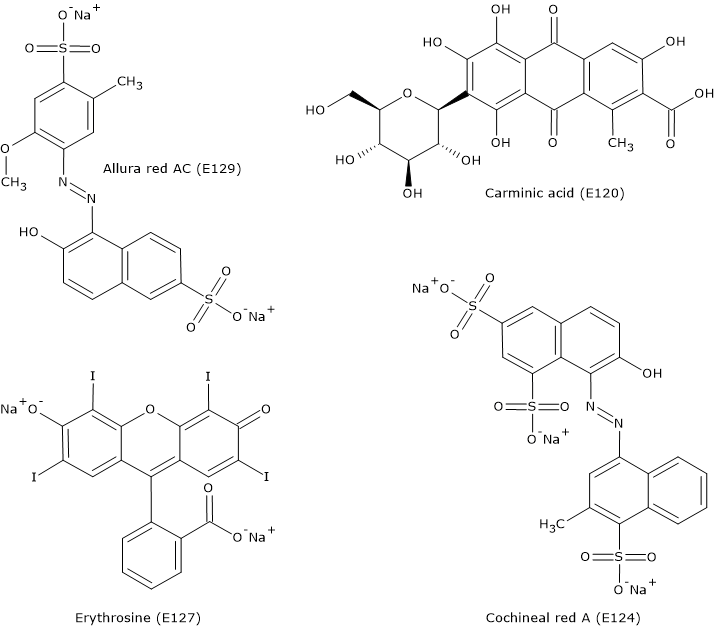
Like other food additives, colours can be natural or artificial.
Natural food colours include both plant-derived and animal-derived molecules.[6]
Examples of plant-derived colours are lycopene (E160d), lutein (E161b), and beta-carotene (E160a(ii)), which are carotenoids. Some anthocyanins (E163), the only coloured flavonoids, and chlorophylls are also plant-derived colours.[8]
An example of animal-derived colour is carminic acid (E120), or more precisely, its aluminium salt. Carminic acid is extracted from cochineal (Dactylopius coccus), which is believed to use it as a visual deterrent secreted when attacked by a predator.[9][10]
Finally, an example of an artificial colour is Allura red AC (E129), initially used as a substitute for amaranth (E123).[11]
Regulation and examples of colours
Below is a review of some colours included in the list of food additives approved in the European Union according to Regulation 1129/2011 of the European Commission, published on 11 November, 2011. This list is an amendment to Annex II to Regulation (EC) No. 1333/2008 of the European Parliament, and was itself amended in 2013.[12]
| E-number | Colour and additive | |
|---|---|---|
| Yellow and orange | ||
| E100 | Curcumin | |
| E101 | (i) Riboflavin, (ii) riboflavin-5′-phosphate | |
| E102 | Tartrazine (= FD&C Yellow No. 5) | |
| E104 | Quinoline yellow | |
| E110 | Sunset yellow FCF; orange yellow S (= FD&C Yellow No. 6) | |
| Red | ||
| E120 | Cochineal; carminic acid; carmines | |
| E122 | Azorubine; carmoisine | |
| E123 | Amaranth | |
| E124 | Ponceau 4R; cochineal red A | |
| E127 | Erythrosine (= FD&C Red No. 3) | |
| E129 | Allura red AC (= FD&C Red No. 40) | |
| Blue | ||
| E131 | Patent blue V | |
| E132 | Indigotine; indigo carmine (= FD&C Blue No. 2) | |
| E133 | Brilliant blue FCF (= FD&C Blue No. 1) | |
| Green | ||
| E140 | Chlorophylls and chlorophyllins: (i) chlorophylls, (ii) chlorophyllins | |
| E141 | Coppercomplexes of chlorophyll and chlorophyllins | |
| E142 | Green S | |
| Brown and Black | ||
| E150a | Plain caramel | |
| E150b | Caustic sulphite caramel | |
| E150c | Ammonia caramel | |
| E150d | Sulphite ammonia caramel | |
| E151 | Brilliant black BN; black PN | |
| E153 | Vegetable carbon | |
| E155 | Brown HT | |
| Carotenoids | ||
| E160a | Carotenes: (i) mixed carotenes, (ii) β-carotene | |
| E160b | Annatto; bixin; norbixin | |
| E160c | Paprika extract; capsanthin; capsorubin | |
| E160d | Lycopene | |
| E160e | trans-beta-apo-8′-carotenal (C30) | |
| E160f | Ethyl ester of beta-apo-8′-carotenoic acid (C30) | |
| Other Colours | ||
| E161b | Lutein | |
| E161c | Beta-cryptoxanthin | |
| E161g | Canthaxanthin | |
| E162 | Beetroot red; betanin | |
| E163 | Anthocyanins | |
| E172 | Iron oxides and hydroxides | |
| E174 | Silver | |
| E175 | Gold | |
| FD&C = USA abbreviation for synthetic colours permitted in food, drugs and cosmetics. | ||
Health effects
The safety of food colours is a major concern, as their use is not essential for food preservation.
Scientific evidence indicates that, when used in accordance with current regulations, they do not pose a health risk. However, the competent authorities in the field, such as EFSA in the European Union, or the Joint FAO/WHO Expert Committee on Food Additives at the global level, continue to evaluate their safety, updating assessments when new evidence emerges or further research is needed, as in the cases of vegetable carbon (E153), iron oxides and hydroxides (E172), silver (E174), and gold (E175).[1]
Nonetheless, ongoing monitoring remains essential, especially in the case of vulnerable populations such as children and individuals with specific allergies.[6]
References
- a b EFSA Food colours. Last reviewed date: 29 April 2025.
- ^ Piqueras-Fiszman B. and Spence C. Sensory expectations based on product-extrinsic food cues: an interdisciplinary review of the empirical evidence and theoretical accounts. Food Qual 2015;40(Part A):165-179. doi:10.1016/j.foodqual.2014.09.013
- ^ Kozelová D., Fikselová M.,Dodoková A., Mura L., Mendelová A, Vietoris V. Analysis of consumer preferences focused on food additives. Acta Univ Agric Silvic Mendelianae Brun 2012;60(6):197-204. doi:10.11118/actaun201260060197
- ^ Spence C. On the psychological impact of food colour. Flavour 2015;4:21. doi:10.1186/s13411-015-0031-3
- ^ Zellner D., Greene N., Jimenez M., Calderon A., Diaz, Y., Sheraton M. The effect of wrapper color on candy flavor expectations and perceptions. Food Qual Prefer 2018;68:98-104. doi:10.1016/j.foodqual.2018.02.011
- a b c Silva M.M., Reboredo F.H., Lidon F.C. Food colour additives: a synoptical overview on their chemical properties, applications in food products, and health side effects. Foods 2022;11(3):379. doi:10.3390/foods11030379
- ^ Figueiredo Muniz V.R.G., Ribeiro I.S., Beckmam K.R.L., Godoy, R.C.B. The impact of color on food choice. Braz J Food Technol 2023;26:e2022088. doi:10.1590/1981-6723.08822
- ^ Gebhardt B., Sperl R., Carle R., Müller-Maatsch J. Assessing the sustainability of natural and artificial food colorants. J Clean Prod 2020;260;120884. doi:10.1016/j.jclepro.2020.120884
- ^ Deveoglu O. A review on cochineal (Dactylopius coccus Costa) dye. Res J Recent Sci 2020;9(3):37-43
- ^ Eisner T., Nowicki S., Goetz M., Meinwald J. Red cochineal dye (carminic acid): its role in nature. Science 1980;208(4447):1039-42. doi:10.1126/science.208.4447.1039
- ^ Human Metabolome Database: Showing metabocard for Allura red AC (HMDB0032884). Human Metabolome Database. 11 September 2012. Retrieved 22 November 2022.
- ^ Commission Regulation (EU) No 1129/2011 of 11 November 2011 amending Annex II to Regulation (EC) No 1333/2008 of the European Parliament and of the Council by establishing a Union list of food additives. https://eur-lex.europa.eu/eli/reg/2011/1129/2013-11-21
Domande Frequenti
What exactly are food colours and what do they do?
They are technological additives used by the food industry to impart, enhance, or restore the color of foods. They help compensate for color loss during processing and improve the overall visual appeal of commercial food products.
What is the main difference between natural and artificial colors?
Natural colorings derive from plant, animal, or mineral sources, whereas artificial ones are produced via chemical laboratory synthesis. Both undergo strict safety testing before being authorized for use in foods.
Are food colorings authorized in the European Union safe to eat?
Yes, all food colors identified by E numbers and authorized in the EU are safe. EFSA scientifically evaluates them and establishes acceptable daily intake levels to entirely rule out any risk to consumer health.